News story for sale or rent

After a year of following the U.S. presidential election, we at Turpin Laboratories have pretty much grown tired of being shocked and indignant. But we’re still not above “piling on” when the media spotlight catches someone in an ethical grey area.

Here you can find a good story by CBC Nova Scotia on the cost to taxpayers of promoting the annual gift of a large fir tree to Boston in 2015.

Here, three days later, you can find the Halifax Examiner’s Tim Bousquet noticing that part of the cost was $25,000 to obtain news coverage of the event from CTV.

No doubt CTV will say that it’s a sponsorship arrangement, not the sale of news coverage; that they are proud to be supporting such an important part of Nova Scotia’s friendship with Boston; that Bousquet is wilfully misinterpreting the contract; that Bousquet is taking it out of context; that CTV would be covering the event in any case and, further, blah, blah, blah.

As noted at the top, at T-Labs, we’re like, whatever.

You can decide for yourself by clicking on the link below. If you’re pressed for time, go straight to Page 7.

tree-for-boston-ctv-offer

We got smoke here. Will there be fire?

Premier Stephen McNeil’s cabinet has stealthily changed the environmental assessment regulations to make it easier to build a waste-to-energy incinerator, a.k.a. burning garbage to generate energy.

Anyone opposed to one of these projects now has less time to react. Proponents of them–now designated for Class 1 environmental assessment, down from Class 2–have to post notice in a local and provincial newspaper within seven days of registering it with Nova Scotia Environment. The public has 30 days to comment after the registration, leaving 23 days if the proponent waits the full seven to publish the notice. That is not enough time to respond to what will inevitably be a complex proposal. In gov-speak, this falls under the heading of “(reducing) unnecessary regulatory burden”. (See below)

Of course, the minister of environment can extend the comment period if she believes “blah, blah, blah”.

The net effect is

367px-district_heating_plant_spittelau_ssw_crop1
Waste to energy plant in Vienna

that if you don’t like waste-to-energy burners, you’d better read the papers regularly and be prepared to move fast.

If you take comfort in the  list of materials banned from incinerators, just remember you are reading this post because changing regulations is dead easy.

(Disclosure: Turpin Labs has an indirect  interest in this issue with respect to used tires.)

Just understanding the process set out in the revised regulations will take you a couple of days and you’ll probably need a lawyer.

And if you fail to spot the official notice of the project in the Bupkis News-Scimitar, well, good luck to you.

There are plenty of reasons for opposing waste-to-energy plants, not least of which is that burning things produces greenhouses gases, which produce extraordinary droughts in Southern  Nova Scotia and floods in Cape Breton, among other nasties.

And the rejection of waste-to-energy more than 20 years ago in Halifax was key to the development of Nova Scotia’s celebrated waste management program.

But, hey, that’s what public comment is for. Remember, you’ll have 23 days to file it.

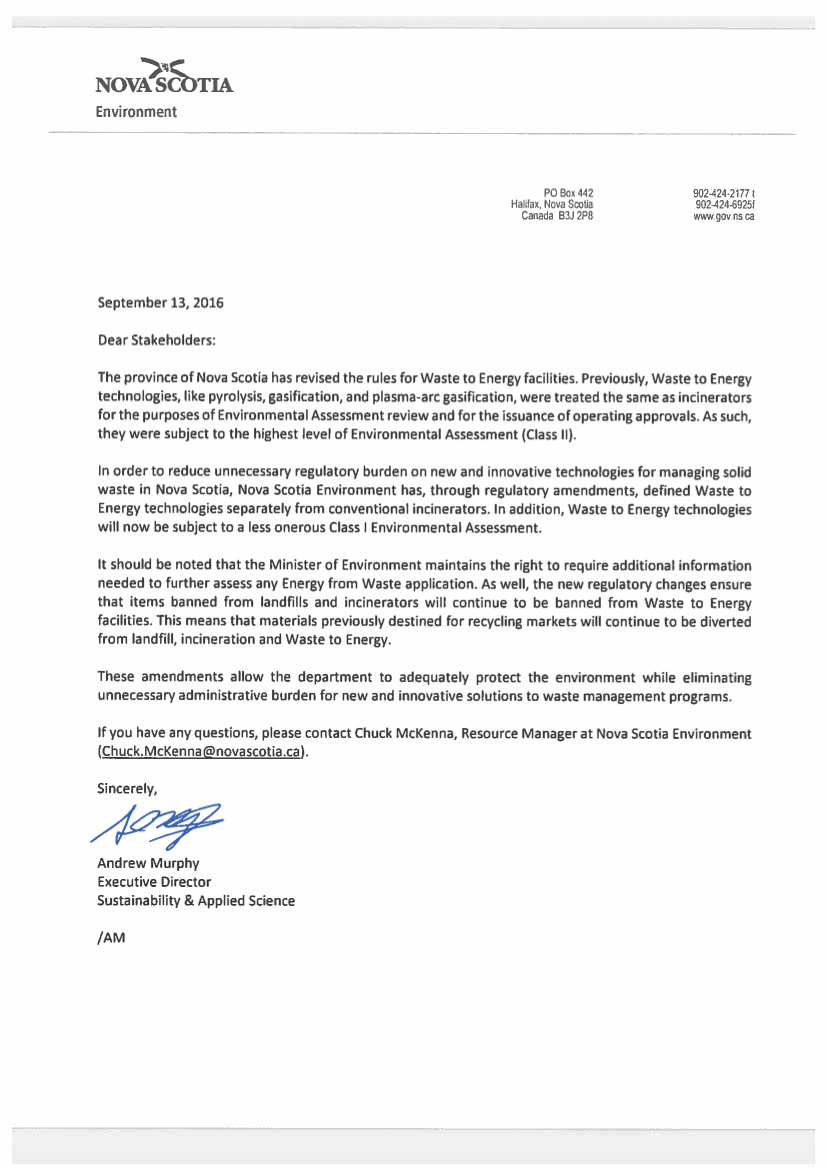
Which makes T-Labs cynical about the way this change was announced: On September 13, NSE sent a letter (below) to “stakeholders” explaining the change. If stakeholders included Nova Scotia media, the government forgot to tell them–there was no media release. Consequently, a Google search turns up only coverage from two trade publications, both of which follow regulatory changes closely by, we imagine, subscribing to the Nova Scotia Royal Gazette (which, if you’re wondering, has neither comics nor crossword).

You can also find the regulation change in Cabinet’s official Order-in-Council 2016-224, which is a public document known mostly to insiders. In the OIC, you’ll find references to a “Report and Recommendation”, which is even more of an insider document. It is typically a tedious read, but it does contain actual information. As of this writing, Cabinet support staff were unable to help Turpin Labs obtain a copy before Tuesday.

For further reading, NSE’s website has an FAQ on environmental assessments. It was last updated on March 31, 2014.

Or try Metro Vancouver halts incinerator plans, as waste plummets.

stakeholder-letter-energy-to-waste

Solar power cheaper than NSPI

If you enjoy decent sun exposure, you can install solar electric panels on your house and begin earning a profit the next month while making a big-time reduction in your carbon footprint.

solar-pv-flower-scaledThere’s no magic to this, no rebates are required, and the math is easy.

The average Nova Scotia home consumes about 10,000 kilowatt-hours of electricity, or kWh. Each kWh, taxes-in, costs around $0.155 when you buy it from Nova Scotia Power. That works out to $1,550 per year.

Let’s say you install enough solar photovoltaic panels, known as solar PV or just PV, to generate the full 10,000 kWh. In Halifax, that would require panels with a generating capacity of about 9,300 kW (known to solar nerds as kWp).

It’s hard to get an online estimate of the cost in Nova Scotia, but there’s a company in P.E.I. that will install that — for Islanders —  for about $19,500. (Actually, P.E.I., gets more sun, so it might cost Islanders as little as $15,700. Maybe you, too, if you live in a sunny spot.)

Seems high, right? But what if you mortgaged $19,500 at 4.54% with a 25-year amortization, terms I picked at random from Canadian Banks? The answer is annual mortgage payments of $1,301, including principal. That’s $250 less than you’re paying now for electricity.

Each year you pay in $1,301 and you get back $250 for your trouble. Presto! A profit.

At Turpin Laboratories, we have access to credit at 2.89%, so our annual cost would be $1,094.

It works out to $0.11 per kWh versus the $0.155 per kWh from NSPI. By the way, this is not so different from what power utilities do: they borrow money to build massive power plants and pay it back, plus interest, over the life of the equipment. The nice thing about PV panels is they require almost no maintenance, are guaranteed for 25 years and could last as long as 40 years.

And here’s the best part: based on NSPI figures, you would be reducing your GHG emissions by 6,520 kg (carbon equivalent). This is the equivalent of taking 1.3 passenger cars off the road, or not burning 3,159 kg of coal

But, you ask, the sun doesn’t shine 24/7, so what do I do when it’s dark?

Well, in Nova Scotia we have a thing called net metering for households. In a nutshell, it means NSPI has to buy any excess electricity your panels produce at the same price they charge you for their electricity. So, to over-simplify, they pay you for excess generation during the day and you pay them for their electricity at night. Periodically, you and the company do the math: you subtract what they sold you from what they purchased from you and settle the bill. At Turpin Labs, it means NSPI would cut us a cheque for $450 at the end of the year.

And this works for any number of PV panels. (Two to four thousand watts (Wp) is common.) Add more for your electric vehicle and —wow — you are star at saving humans from climate change. Plus, your electricity and auto fuel bills total zero.

It’s important to shop around and do your homework. This a new industry, so ask tough questions — there’s plenty of info available on the web.

If you can’t get a reasonable forecast about your generation potential, then move on to another installer. If someone is offering you panels than generate much more than 1.1 kWh annually per kWp of panel capacity (kWh/kWp  now that you know the lingo), start asking questions. Natural resources Canada has detailed and relevant local data here.

But you can’t go crazy and actually compete with the power company. The amount of solar capacity you install has to be consistent with your needs.

Has Turpin Labs done this? No, because we’re reluctant to take on new debt in the Lab’s development, despite the rock-solid logic of the proposition. It’s just psychology. This is where a rebate from, say, Efficiency Nova Scotia, could make a difference in combatting climate change.

“Wow, Turpin Labs,” you say. “This is great! Why aren’t the government and NSPI promoting the heck out of this to help fight climate change?”

Well, at a certain point residential generation becomes a problem for power utilities and that’s a problem for governments, even ones that campaigned on putting the powerco in its place.

More on that in a future post.


Order! Order, please!

Here are some questions about the procedure for  tomorrow’s HRM Regional Council agenda (Sept. 6). Perhaps there are some experts out there who can help us.

1. HRM Counc. Reg Rankin’s motion to hobble the acquisition of parkland for Blue Mount-Birch Cove project is the first item on the agenda.

The motion was deferred on July 26 so that staff could prepare a report on the situation for Council. But now they’re going to consider Rankin’s motion before the report is introduced, so what was the point in deferring the motion in the first place? How does Council get the full benefit of the report if it doesn’t have a chance to discuss it before Rankin’s motion?

Q: Is this an abuse of procedure?

2. Rankin’s motion and the motion that follows the staff report on the agenda are antithetical. For example: the first motion directs staff to begin “secondary planning”; the second motion is to refuse to engage in secondary planning. So, chronologically, we have two deeply conflicting motions separated by a staff report on the matter at hand.

Q: Is this good procedure?

3. Rankin’s motion arguably contradicts at least two previous ones directing staff to proceed with land acquisition in a businesslike fashion.

Q: Does it nullify the previous motions? Technically, is it effectively a motion of rescission? Does that mean it would require a two-thirds majority to pass? Is it out of order? (See http://bit.ly/2ce7c9X , Article 62, beginning on Page 30.)

Again, knowledgeable comment would be helpful here because citizens have no way of raising a point of order at a Council meeting. If you can help, the best place to contribute is likely the FB site where you found the link to this post.

Procedure aside, Rankin’s motion is mischievous and insulting to the 1,421 citizens who submitted comments in support of a project that will benefit our descendants more than it will benefit us. When is that last time 1,421 people spoke up for something instead of against it?

***

In online discussions, people have noted that Halifax councillors—on average—got one-third of their campaign contributions in 2011 from what CBC calls “the development community.” It’s a little naïve to think this amounts to bribery. Only a fool would risk a jail sentence for a few thousand dollars to help a campaign they might not win. Real bribes are more sophisticated and not the topic here.

But campaign contributions get you better access to the winners you backed. This is legal, and even ethical—we all have the right to speak to elected representatives. Political parties trade access for contributions in plain view at fund-raisers.

So what? Well, examine your feelings when you’re in the presence of power and money. You’ll likely find a powerful desire to co-operate.

That’s the real problem. Without strong self-discipline, meeting with the mighty can bring out your inner brown-noser. No cash required.